Tuesday, August 28, 2012

Going for the Gold


Nearly a decade after Jack Goldstein’s suicide, his hungry ghost has yet to make peace with his artistic hometown, Los Angeles. 

One of the first casualties in the lurching institutional gearshift of Jeffrey Deitch’s arrival at L.A.’s Museum of Contemporary Art (culminating with Paul Schimmel’s unceremonious firing from his 22-year tenure as chief curator), “Jack Goldstein X 10,000” — the artist’s first North American retrospective, on view through September 9 — was shunted south, to the tony but off-the-beaten-track Orange County Museum of Art.
 
Back in the 1980s, OCMA was the Newport Beach Museum, where Schimmel cut his curatorial teeth and made his initial impact on the L.A. art scene. The circularity, careerist intrigue, and absurdity of the situation would probably have delighted Goldstein, though it might just as well have given him stomach cramps.


Goldstein’s name is unfamiliar to many, though at one point his stock was ranked equal to such fellow travelers in the Pictures Generation and Neo-Geo movements as Richard Prince, Cindy Sherman, and Jeff Koons, as well as John Baldessari, David Salle, Ross Bleckner, James Welling, and other community members from the newly founded California Institute of the Arts in the early ’70s.


Dubbed the CalArts Mafia, this tightly knit, ambitious circle was the subject of Goldstein’s last testament: Jack Goldstein and the CalArts Mafia, his spectacular collaborative oral autobiography with Richard Hertz (and 11 other contributors), which manages to be both bleak and exhilarating in its unflinching examination of the neurotic machinations behind art world success and failure.


Failure is the lurking terror throughout the volume — originally published in 2003 and recently reissued by Minneola Press — and some pathological pas de deux with failure led Goldstein to hang himself a few days after finalizing the book’s contents and design. Having burned most of his bridges through an abrasively confrontational interpersonal style and a spiraling appetite for hard drugs, Goldstein found himself forgotten by the mid ’90s, living without electricity in a trailer amid the cholo culture of East L.A. and working as a day laborer to pay for his daily junk.


Tabloid titillation aside, these biographical dimensions lend tremendous gravitas to Goldstein’s work, whose dark humor, theatricality, control-freak precision, and ostentatious disinterest in the physical experience of creative action might seem as affected as Koons’s if they hadn’t been backed up with the most anti-physical control-freak theatricality possible. The obliteration of the figure, the dismantling of the artist’s presence, the poetic obsession with recurrence, duration, and ephemerality — and other motifs that crop up throughout Goldstein’s career — are, ironically, fleshed out and made more substantial by the artist’s final disappearing act..."


Even his drastic serial abandonment of one genre after another, one signature style after another, could be said to reach its logical extreme with that one last jettison. By his own (quite convincing) account, these shifts were more opportunistic plays/acts than evidence of any overarching conceptualist strategy. While an undergrad at the Chouinard Art Institute along with Laddie John Dill and Charles Arnoldi, Goldstein made Postminimalist sculptures from unadorned lumber and molded Plexiglas. Such mute formalism didn’t fly when he moved on to CalArts, so he reinvented himself as a Chris Burden-like performance artist and a filmmaker in the vein of Bruce Nauman, William Wegman, and Michael Snow.


Part of Los Angeles’s uncertainty toward Goldstein had to do with his being in the last generation of local artists who felt compelled to pursue their career in New York City, though he kept a foot in Hollywood for the easy access to film technology. The early ’70s was a period when many of the leading art critical lights saw cinema as the only way forward out of modernism’s endgame, so Goldstein was able to stick with the medium for several years, tightening and refining his narrative and aesthetic vocabulary and developing a distinctive voice — albeit one that spoke from a ventriloquist-like remove. For it was during this phase that Goldstein — following Baldessari and Warhol — began to systematically remove himself from the physical processes that produced his art.

“The Jump,” 1978, is given place of honor in the OCMA show as a continuously projected loop in the exhibition’s entrance. And rightly so — it is the masterpiece of Goldstein’s film work, possibly of his entire career. Yet it’s a work that is barely there, and Goldstein’s role in it was essentially supervisory. A mere 26 seconds of footage — three shots of a diver leaving the high board, sampled from Nazi aesthete Leni Riefenstahl’s “Olympia,” 1938 — is given a disco-psychedelic makeover by a team of professional Hollywood rotoscope animators. The result distills the paradox of Jack Goldstein: In spite (or because) of his insecurities, his pathological careerism, and his profound disengagement from authorship and material process, “The Jump” is hypnotic and entertaining, formally exquisite and conceptually rigorous, entirely derivative, and wholly original.


Some of Goldstein’s films are even shorter. “A Ballet Shoe,” 1975, shows a dancer’s foot en pointe. Two hands untie the bow of her slipper, and the dancer’s foot relaxes to a more natural position. Nineteen seconds. In “White Dove,” 1975, hands move up to form a triangular frame in front of the titular bird, which then flies off its perch. Twenty seconds. These works operate at a tangent from Goldstein’s slightly longer loop-based work, emphasizing duration with their minimal, punch line-determined narrative structure. Unlikely as it seems, it was this joke structure that provided the bridge for Goldstein’s transition to painting.


As the ’70s wound down, painting underwent a surprising resurgence under the rubric of “New Image” or “Neo-Expressionism,” a mishmash of often deliberately awkward figurative styles from Europe and America. A number of Goldstein’s colleagues — Salle, Bleckner, and Eric Fischl in particular — were at the center of this cyclone and began moving product hand over fist. Goldstein, despite the fact that he was already garnering attention as a member of the patently anti-painting Pictures Generation, wanted in.


His first forays into painting territory retained much of the Conceptualist animosity toward the predominant Greenbergian theoretical model. Works such as his two untitled triptychs from 1979 imposed a familiar durational punch line narrative on the viewer, but shifted it from a passively endured cinematic sequence to an interactive perceptual choreography. And it’s a pretty good art joke: Paintings that appear from a distance to be Minimalist monochromatic fields à la Brice Marden resolve into vast spatial voids punctuated by tiny, carefully rendered figures of astronauts, parachutists, or deep-sea divers. Carefully rendered by Ashley Bickerton, that is — or one of the other assistants Goldstein hired to execute his vision.

Weirdly, Goldstein’s major legacy may have been his role in shifting the deliberately provocative outsourcing of art manufacture, as in the work of Warhol and Baldessari, to the industrial infrastructure of the contemporary global art market. Part of this is due to the downplaying of this aspect as one of any number of postmodern displacements at play in his work. But mostly it’s because Goldstein took advantage of the plausible Conceptualist deniability afforded by this authorial indeterminacy to sneak the long-banished qualities of aesthetic beauty, poetic resonance, and meticulous craftsmanship back into the dialogue of painting. How was he to know it would wind up meaning a Damien Hirst dot painting in every home?


Whatever its historical repercussions, that loophole resulted in an outpouring of one of the most dazzling and coherent bodies of painting produced in the 1980s. Goldstein quickly abandoned the structure of his figure-ground gag pictures for isolated, outsized images of luminous obliteration — rocket bombardments, volcanic eruptions, eclipses, lightning strikes, digitized images of the body derived from medical technology. Appropriated from popular magazines, rendered with a variety of depersonalizing techniques (airbrushing, pinstripe rollers, intricate layers of masking tape), and framed and interrupted by brightly colored geometric bands and sprockets, Goldstein’s decade of paintings managed to combine an infuriatingly mute literality with a through-the-looking-glass romanticism that remains paradoxically fresh, personal, and original to this day.


After giving up painting, Goldstein spent his final decade compiling idiosyncratic autobiographical aphorisms into poetic clusters, completing an enormous body of work that is virtually unknown today. There’s an entire oeuvre of LP records over-lapping Goldstein’s transition from film to painting, curious minimalist versions of musique concrète compiled from commercial music and sound-effect libraries, whose significance in the history of sample-based audio collage composition has yet to be assessed. One of the most engrossing works in the OCMA exhibition is “Burning Window,” a highly cinematic 1977 installation that gives a strangely soothing impression of an immense landscape immersed in flames. 


But it is the paintings that seem to have pulled the most out of Goldstein. Which makes sense, because in spite of the commercial acuity of embracing that oldest of genres, it was a tremendous — and perhaps poorly calculated — risk in terms of the critical dogma then prevailing in his community. Goldstein’s genius was to recognize that if painting actually had anything left to say, he had to transform his art-making practice into a ventriloquist’s dummy, because sometimes channeling all the unspeakably awkward taboos through a puppet is the only way to move the conversation forward.


 "Getting Right with Risk" was originally published in the September 2012 print version of Modern Painters


Images: The Jump 1978 16mm film still; Some Butterflies 1975 16mm film still; Untitled 1979 Oil on Masonite (followed by detail); Untitled 1981 Acrylic on canvas; Untitled 1981 Acrylic on canvas; Untitled 1983 Acrylic on canvas; Untitled 1988 Acrylic on canvas; Totems: Selected Writings 1988–90 one of 100 computer print-outs


Listen to Jack Goldstein's records here, and view his films here. The show was up at OCMA through Sept 9th 2012

Thursday, August 16, 2012

Irvine is Fine

First Prize: Khang Nguyen Absorbing Nocturnal Qualities oil on canvas

After showing P'fool in the AM and driving the 4 hours back from Lompoc the other Saturday, I had just enough time to unleash MA & the hounds and jump back in the car to get down to the Irvine Fine Arts Center to hand out the prizes for the IFAC All Media 2012 show, for which I was juror.

Second Prize: Sharon Hardy Map QuestCeramics, silver, aluminum

Third Prize: George Long Little Corona mixed media

These kinds of shows are frequently disparaged in the upper echelons of TAW (The Art World) but I find them extremely interesting - not least for the evidence they provide of widespread and vigorous creative activity taking place beneath TAW's radar.

Honorable Mention: Joseph Van Hooten Fullerton/Wall Mixed Media (84 X 120!)

Honorable Mention: Jong Ro Bliss oil on canvas

Honorable Mention: Lisa Dallendorfer Staving Off Dementia Mixed Media (origami cubes from Sudoku games)

Honorable Mention: Byong-Ho Kim Tree Farm Photograph

LA gallerist/curator Carl Berg has returned to IFAC, where he worked for several years back in the day, and he's trying to establish the IFAC as a fulcrum for the LA and OC art communities - starting with the multi-curator extravaganza Curatorial Exchange, which opens Sept 8 and runs through Oct 20, and includes sections curated by yours truly, Micol Hebron, Roger Herman, Christopher Pate, Max Presneill, Laurie Steelink, Inmo Yuon, HK Zamani, and more!

Concurrent with the All Media 2012 - which closes Aug 25 - is a $99 fundraiser show with some awesome work. In spite of the fact that I've been living on credit since 2008, I scored this boss abstraction by Nancy Evans (above) and this watercolor monoprint of a pig in a wallow by Tanya Brodsky (below).


Monday, August 13, 2012

Hear the Todash Chimes!


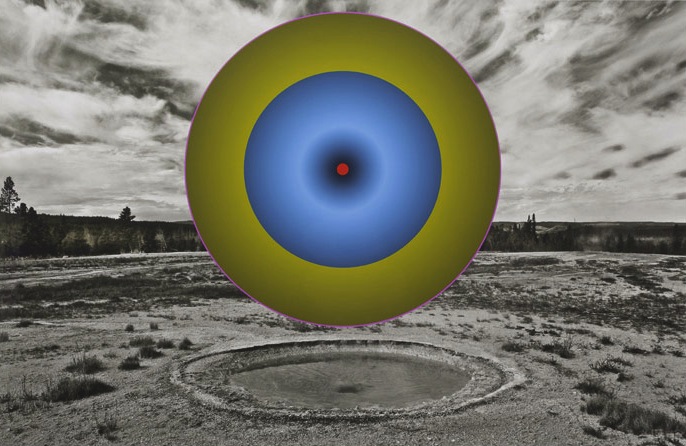
"Throughout his variegated career and across a broad range of media — including painting, drawing, photography, sculpture, and various hybrids — Don Suggs has frequently tinkered with the sacred geometry of the modernist picture plane, subjecting it to unholy alliances with classically mimetic picture-making, usually in the form of pictorial landscapes. Recently his geometric fixations, in this capacity and otherwise, have narrowed to the ideal form of circles composed from infinitely variable bands of concentric color; an iconic visual trope throughout art history, but one of particular centrality to a wide range of modernist strategies, from Kandinsky, Duchamp, and Hilma af Klint to Alfred Jensen, Jasper Johns, and Kenneth Noland. Though these affinities inform Suggs’s work, his principal interest is the structure and dynamic of translation from illusionistic to abstract modes of representation.

The works from his Patrimony/Matrimony series, begun in 2006, derive their rings of color — meticulously applied onto round canvases up to nine feet in diameter using a purpose-designed turntable “easel” — from the palettes of great paintings from across the history of art. It’s something like a spectrographic readout, or core sample. Several other series applied the same formula to archetypal Western American landscapes, either in pure tondo form or as abstract insertions into black and white photographic depictions of the original source location. It’s at this point his most recent exhibit picks up..."


Read the rest of Don Suggs: Abyss Pools and Travertine Springs in ArtVoices

See the show online at LA Louver

Images: Omphalos; Tioga Pass (both 2012 archival inkjet prints)

Sunday, August 12, 2012

Oh the Humanities!


I heard this on KXLU while I was driving to OTIS to talk to the Graphic Design students about zines and the impossibility of subcultures in contemporary society. I was all like "Ha ha this old postpunk song sounds like they're singing about the Jurassic." I didn't really believe it until I tracked it down on Soundcloud. Not sure what it all means, but it's all pretty catchy.


They mention M.A.'s space dog portraits and there's a line that goes "There's a dude in a hologram... and he's hounded!" which could either be referring to yours truly, or Christian Cummings' dad. Either way, whatever, right? Clearly we are living in the End Times. Here's a more ramshackle live-in-studio version. Gotta catch these guys playing out.

Thursday, August 9, 2012

My first feature for ArtVoices - Go Figure


It’s an Origami Moment!” exclaims the email announcement. “MIT trained engineer Dr. Jeannine Mosely has discovered a new fractal, the Mosely Snowflake Sponge. The USC Libraries has taken up the challenge to build this amazing form out of 49,000 business cards. During summer 2012, workshops will be held at the USC Doheny Library and at the IFF’s new Chinatown space to make this fractal sculpture. We invite you all to come and help!”

You wouldn’t expect a cutting-edge cultural institution to be expending such enthusiasm over something so, well, totally geeky. But the Institute for Figuring (IFF) knows their audience, and they know what works for them. It was, after all, a closely related project — the 2006 presentation of Mosely’s Business Card Menger Sponge, a piecemeal collaborative construction involving nine years, hundreds of volunteer origamists, and 66,048 business cards that resulted in a nearly seven-foot-tall sculptural artifact — that helped establish both the IFF and host venue Machine Project as forces to be reckoned with in the Los Angeles art world.


The fact that the final form of the Business Card Menger Sponge was nearly a textbook illustration of serial Minimalist sculpture circa 1971 — a monochromatic 81-inch square cube riddled with precise rectilinear gaps determined by a fractal equation — added a droll art historical subtext to the presentation, but it wasn’t nearly as superficial or coincidental as it may have appeared.

As compelling as the best of the math-and-science-fetishizing geometric abstractions of that era were (and many dovetail elegantly with the IFF’s vision), there was a hidden Puritan agenda at work — Pure Science’s alleged lack of distracting sensuality was employed to gain leverage in an overlong argument between Romantics and Neoclassicists about whether purple was a number or a feeling. “See? If Art is meant to reflect reality, and Math and Science — the best tools we have for describing reality — are colorless and boring, then the only Pure Art must be as colorless and boring as reality!”


The problem is, science and math were never colorless and boring; they just didn’t have colored ink for computer printouts in 1971. The IFF knows this, and part of their mandate would appear to be the rehabilitation of the hard sciences from their paradoxical reputation as harbingers of a posthuman anesthetic gray haze and to recognize them for the sensually hardwired, beyond-psychedelic, non-verbal languages that they are. At least that’s my take. The IFF takes a more modest tack, identifying their core concept as “material play… a new, hands-on approach to public science education that is at once intellectually rigorous, pedagogically rich, and aesthetically aware.”

As reassuringly public-service as that sounds, it doesn’t quite capture the organization’s penchant for uncovering and celebrating some of the most idiosyncratic visionary individuals operating in the world of science, a leaning that goes back to their very beginnings. The IFF came into being around the time and occasion of a remarkable exhibit at the Santa Monica Museum of Art in the fall of 2002, entitled Lithium Legs and Apocalyptic Photons: The Imaginative World of James Carter. Carter is a trailer park owner in Enumclaw, Washington who has spent most of his life — when not prospecting for gold or diving for abalone — developing unique and radical theories to replace what he feels to be the inadequate physics of the quantum era...

Read the rest of Go Figure: Los Angeles’ Most Quizzical Institution Finds a Home here, or after the jump.


Images: Diver Al Giddings blowing a circular bubble underwater; Institute For Figuring's Chinatown exhibition space featuring Physics on the Fringe; Diagram of Jame's Carter's theory of subatomic particles; Detail of the Periodic Table, as described by James Carter's theory of Circlon Synchronicity

Another Archival Discovery


Here's a long-lost Flash Fudd rarity - a strip I did to run along the bottom of my four-page zine The St. Sebastian Record Player and Telegraph Historical Revue circa 1990. I thought the original was lost, and only had a xerox copy of the zine, but found it in my recent excavations. It was originally intended as one long horizontal sequence, but I reformatted it as a grid for online viewing convenience.

Wednesday, August 8, 2012

Exit Strategy


I received this remarkable leaked document in my inbox and thought I should air it out. The only trouble is that these ideas are TOO good. If Jeffrey Deitch followed these step-by-step, he'd win the love and respect of the entire universe. Though a more moderate solution might be to promote Ms. Glueck to that newly restored Chief Curator position.


6 August 2012

TO: Jeffrey Deitch, MOCA director
FR: Samantha Glueck, MOCA curatorial intern
Re: Ideas for future exhibitions

Dear Mr. Deitch:

You may not know me, but I’m the summer curatorial intern. I’m a huge fan of yours, and of course of MOCA. I must say, however, that I would have had to be on Mars to not be aware of your recent…troubles. (Even the café is offering a new drink to staff members -- a MOCA Flappé.) Of course I read all of the news reports – of you forcing the esteemed curator Paul Schimmel out, then saying he had resigned, and ‘honoring’ him by naming that loft space at the Geffen after him. Well, that was nice, but then all of those nasty stories in the newspapers. Boooo! And cranky old Charles Young with his leaked email to Eli Broad -- what a sneak! As for the artists who resigned from the board, all I can say is, di-no-saurs: Krugerraptor, Edyrranus, Cathyopus, Baldessaurus Rex!

I have been feeling so sorry for you, Mr. Deitch. Of course, I felt a little less sorry when I read that you make $650k a year. Really?! I make, like, $650a. In any case, I hope it works out that you can stay at MOCA, and continue doing a great job. I hope you don’t find this impertinent of me, but maybe because of my age, and super-big interest in pop culture, I think we have a lot in common. Well, not age, of course – I’m like, still young.
But I think we can agree that what MOCA really needs are a few killer shows that hit all the notes, exhibitions that are relevant to today and the younger, hipper audience we want, yet steeped in scholarship. Well, maybe not steeped. Dipped. Like The Dark Knight Rises, only art.

No, the movie title is not a veiled reference to Paul Schimmel, haha. Anyway, I hope you like my ideas:

The Female Gaze: An ongoing series with Marina Abramovic
I know, I know, my friend Jason told me she always makes him think of that character in Sartre’s The Age of Reason, who says, “When I look at her, I understand Sadism.” But Abramovic is also a buzz magnet, and all she really needs is a couple of chairs, right? Hello balanced budget!

What Is…A Readymade??? Trivia and Categorization in Art History
Guest curator/host: Alex Trebec. Jeopardy broadcasts from MOCA for the run of the show. Special competitions between the art schools, gallerists, curators, museum directors. Cue weird electronic swoosh and music: “From the Museum of Contemporary Art in Los Angeles, this…is…Jeop-ardy! Now entering the studio are today’s contestants: Originally from Bergisch Gladbach, Germany, a curator, Klaus Biesenbach. Originally from Los Angeles, California, a gallerist, Larry Gagosian. And originally from New York, New York, our returning champion, Jeffrey Deitch, whose total winnings of $34,000 is nearly as much as MOCA’s endowment.” Just kidding about that last part!

The Girl With the IKEA Tattoo: Swedish Romanticism from Gustav the Great to Spotify
Literature, music, fashion, furniture – and a dash of history. Anyone who thinks the sponsorship possibilities -- IKEA, H&M, Soundcloud and yes, Spotify -- have something to do with this is a very shallow person. ;) Raves with Euro DJs, interactive electronica kiosks, runway shows, panels on detective fiction and a few old Anders Zorn paintings thrown in. ABBA performance? (Are they, like, still alive?) Could we get IKEA to donate 20,000 of those little meatballs for the opening? With lingonberries? Please?

Friday, July 27, 2012

Lompoc Report Part 1


Nigel's triumphant Rally-O debut. He scored a 95. He has his first leg.

Thursday, July 26, 2012

"I'm Garfield... Fly Me!"


I've been agitating for this Sunset gutter find as a contender for the CCCP-SCC's backyard cinema research seminar, but I'm afraid to actually check it out. I'm guessing its some kind of low end virtual reality simulation; mildly S/m interactive porn for middle-aged female fans of Garfield. And not that pretentious hi-falutin Bill Murray version of Garfield either. I initially read G's airline pilot getup as a Gestapo uniform, but that would certainly be in poor taste. Science compels me to retire to my laboratory with some Jergens and Kleenex to make a thorough assessment before proceeding...

Wednesday, July 25, 2012

I Hwil Choose Free Hwil


"Everyone else gets a preview of their work, so I thought I should get a preview of my work. I'm so sick and tired of everyone else getting everything they want and me being ignored and hated by people who don't even know me, just like in high school. But maybe this blog will change everything, and I can get on the A-Team again, like I was when I wrote for LA Weekly! Then I'll know that people really really LIKE me!"

Here's a sample of my latest soundwork... I've been feverishly abridging the audiobook version of Wil Weaton's autobiography for the one-night-only HOLODECK show curated by Brad Eberhard as one of PØST's Kamikaze shows this Thursday, July... well, maybe we should just let the press release explain it...
The HOLODECK
PØST
Thursday, July 26th
7-9PM

The Holodeck is a simulated reality facility on the USS Enterprise NCC-1701-D, the primary setting of the American science-fiction television series Star Trek the Next Generation. The characters on the show use the Holodeck for a variety of applications, including recreation, training, and problem solving. Although crew members can program in the environment or scenario they wish to inhabit, they cannot necessarily control their experience once inside. Things go wrong with it pretty regularly. People get stuck inside and can’t get out. Like art, the Holodeck is an ideal world in which refreshment and conflict go hand in hand.

The HOLODECK is a group show whose participants were each given a card from a deck of Star Trek the Next Generation playing cards as a prompt for an artwork. Each person was presented with the option to select a card with a specific character/theme or to receive a card randomly from the deck. The breakdown was about 50/50, specific vs. random. They could use the their card as a source, an object, or the starting point for any manner of conceptual strategy that suited them. The show will include a variety of 2, 3, and 4 dimensional media.

Some participants identified themselves as fans of the show, while others have barely seen it. Regardless, in producing a work for the exhibit, all have approached and interacted with the substantial, multiple–faced icon that is Star Trek the Next Generation. When the work is considered all together, the sly cross-fades with the sincere, creating a curious harmonic dissonance, humming with possibility.

Enter the HOLODECK.

Explore new worlds.

Engage.

Etc.

with:

100xbtr, Jonathan Apgar, Joshua Aster, Theodora Allen, Lara Bank, Leon Benn, Nora Berman, Elonda Billera, Lucy Blagg, Brian Bress, Kristin Calabrese, Joshua Callaghan, Scott Marvel Cassidy, Jimmy Chertkow, Brian Cooper, Sean Duffy, Brad Eberhard, Josh Erkman, Tyler Finnie, galería perdida, Wendell Gladstone, Zach Harris, Asher Hartman, Doug Harvey, Roger Herman, Katie Herzog, Carmine Iannaccone, Matt Johnson, Raffi Kalenderian, Michael John Kelly, Becky Kolsrund, Cyril Kuhn, Julie Lequin, Susan Logoreci, Alan Ludwig, Ashley Macomber, Dana Maiden, Susanna Maing, Amy Maloof, Antonio Puleo, Kelly Sears, Tif Sigfrids, Brad Spence, Rob Thom, Justin Veach, Matt Wardell, Christine Wertheim, Jonas Wood, Rosha Yamghai, Bari Zipperstein

organized by Brad Eberhard

PØST
1904 East Seventh Place
Los Angeles, California 90021
Tel: 213-488-1280
E-Mail: new@post-la.com

Tuesday, July 24, 2012

Everybody's Fancy


Going through a box of potential Less Art content, I came across this 8-track signed to me by Mr. Rogers while he was getting his star on the Hollywood Walk of Fame. I couldn't get close enough, but my late paparazzi friend Terry Lilly managed to break through.

Here's a piece I wrote about Mr. Rogers for Art issues. back in the late 90s...

"The very same people who are wet sometimes
are the very same people who are dry sometimes"
from ‘Sometimes People Are Good’

When I told my 11 year old nephew Andrew on the phone that I was writing an article about Mr. Rogers Neighborhood, he responded with a fairly devastating parody of Mister’s trademark low-key microscopic view of the mundane “..and look! There’s bubbles of air coming out of the fishes’ mouths! Let’s look closer, boys and girls...Isn’t it wonderful?” Andrew then suddenly shed the affectation of adult cynicism, conceding with a hint of nostalgic enthusiasm that the neighborhood of Make-Believe segments had been at least worth viewing, then finished by sharing the inside scoop that Mr. Rogers ‘is gay’ and ‘owned the Pittsburgh Penguins for a year’,

Such complex responses to Mr. Rogers’ deceptively simple oeuvre are not atypical. I first became aware of Mr. Rogers Neighborhood through a number of memorable parodies, particularly Eddie Murphy’s on Saturday Night Live. Subsequently, I began noticing a strange quality to the occasional soft news items about Mr. Rogers, such as the one in which he advocated the expression of unconditional love in settling labor disputes at his family’s tool and die company in Pittsburgh, cast regular Betty Aberlin’s laughing response to a tabloid’s attempt to dig up some behind the scenes dirt: “In real life Fred Rogers is exactly the person you see on Mr. Rogers’ Neighborhood”. Soon I began watching the show regularly, and, after an initial period of harsh skeptical scrutiny, became addicted to the slyly insinuative anarchistic surrealism of, yes, the Neighborhood of Make Believe segments.

These portions, the central, conspicuously Fredless focus of each program, take place in a simultaneous parallel reality accessed by a shamanic trolley-ride through a tunnel to a neighborhood populated by a polymorphous array of animal puppets and live humans, of human puppets and live humans in animal costumes, of animal puppets in human costume, living in castles, trees, clocks, factories, jungles, and museum-go-rounds; in short, a shifting and centerless array of intermimetic archetypal identities and loci put in the service of whatever that week’s ostensible topic of discussion (When Parents Go Away, Monsters and Dinosaurs, etc.) might be, but always seeming to wind up reiterating that any thought or feeling is permitted expression in the realm of the imagination.

Right from the start, we have to observe that the two-to-five-year-olds at whom the program is directed are attempting to consolidate somewhat less baroque material than might spring to the mind of your fully acculturated adult. Thus, some of Mister Rogers’ injunctions and definitions trigger a battery of exceptions and reservations- I, for instance, have never felt that the policemen are there to help me- that might suggest the presence of an exclusionary, judgmental hierarchy. The Neighborhood of Make Believe is, after all, a monarchy. But this impression is wrong. As King Friday XIII himself has stated, “In this neighborhood everyone can decide for themselves what is best.” and Mr. Rogers’ aim is clearly to arm his viewers with a full and intimate knowledge of the status quo, and the powers with which to -oh so peacefully- overthrow it.

For while he never has the denizens of Make Believe act out any of the most transgressive impulses that wrack the pre-genital psyche, he allows all manner of equally disordinate slippages to occur, from the gleeful and elaborate cruelties of Lady Elaine Fairchild to improbable alliances such as the marriage of an aging human ‘drinking straw salesman’ to a talking starfish in order to provide grandparents (the straw salesman being the biologically related but previously absentee party) to a sad tiger. Such convoluted shapeshifting reaches its textual apex repeatedly in the recurring ‘opera’ events staged by the Make Believists, generally to some cathartic and laudably therapeutic end, but invariably a self justifying phansasmagoria of consensual permission in itself...

Read the rest of Zen and the Art of Make-Believe: A Date with Mister Rogers here.

Proof Positive


People didn't believe me when I listed "Jar-Jar Binks All Cotton Toddler Girls' Panties" as a medium in my artworks, but recent archival excavations unearthed the above pictured artifact. Who's laughing now? More discoveries to follow.

Sunday, July 22, 2012

Ciao Bella


Between his sobs, I found out from Lee Lynch that the totally awesome Chumbawumba had announced they were disbanding a couple of weeks ago. If you only know of the band from their hit "Tubthumping" (whisky drink, fall down, get up, etc.), read Aaron Lake Smith's brief history, though I have to take exception to his assessment of their later work as " acoustic lite-techno" - I would characterize it as a valiant attempt to revitalize the British folk-rock tradition. Here's a couple of samples - their (re)recording of the 17th-century "Diggers' Song" (late period) and their scathing rarity "Passenger List For Doomed Flight 1721" (middle post-punk electronic disco period) which is also available as a free legal download from the band's website. Poor Bono!

Haut Bon!


Google translate says:
"At any Honour to whom honor: The Murder of Hi Good by the Ameri-cain Lee Lynch. Inspired by a Real occurred in California in 1870, The film shows the murder brutal the last hunter-In dians, Hiram Good by a blood- mixed. The two men are described as similar in "El Etnografo" by Argentinian Ulises Rosell. DR film, one living in humiliation tion and fear, the other in the glo- laughing his conviction Superiori- ty. Until one day, Ned, the half- Indian alarmed, took a rifle to see what that does to empty its cartridges in the body of a White assumed invulnerable. Inspired by reading the ethno- logue Robert F. Heizer, shot with non-professional actors the ranch that belonged to Hi Good in the town of Vina, co-authored with young Indian activists of the region, the film is a kind of Western chimeric a grotesque cruelty, evoking simultaneously Land Without Bread (1933) One of Luis Buñuel and adventure Billy the Kid (1971) by Luc Moullet. The evolution of the genus is com- crushed me (classic Western, westerncritique, documentethno- graph) and all formats Registration exhausted (from 35 the super-8 via the tele- phoneportable). Lee Lynch explain that this heterogeneity on a little monster: "The principle collage I cared. I wanted use all possible forms gender and technology for finally say that none of they were apt to redeem the atrocity of this story. It fau- drait to reconfigure any this mythology. "It does this in its modest scale. Born here thirty-two years to near the scene of his film, in northern California, from from a modest background, Lee Lynch prospects of political history plastic in its region and Cineas- you: "Between the conquest of the West and the hippie movement, the California is mired in the myth. The iniqui- ty and social racism prevailing in that State are systematically mentsous évalués.Mêmela-against- Culture continues in its own way, the Indian genocide. "But his films, dontcertains cosignésavecla Reali- satrice Lee Anne Schmitt, no hole- Wind not the way the rooms. The Murder of Hi Good has been my- strated in a gallery, in the form installation. For him, the question ing Indian remains taboo: "What do you think of a State which osebaptiser named "Geroni- mo "the operation to elimi- NER bin Laden, without the presi- dent Obama can prove himself in satisfactorily with the Indian community? "

Better Late Than Never


Hot off the presses, Jessica Rath's review of ARATALAND!

"To say that Michael Arata is prolific is almost laughable. “Arataland!,” a retrospective of this Los Angeles-based artist, recently filled more than 20 rooms in the three-story Beacon Arts Building. Walking through hundreds of works, one could imagine that Arata has spent every night of his life furiously cranking work out, most often using sculpture as a way to insert himself into an existing political, religious, and art historical dialogue and interrupt our assumptions about it. Curated by artist and critic Doug Harvey, “Arataland!” was deftly organized into three floors: “It’s Complicatedland,” “Innocenceland,” and “Negativespaceland,” thus providing convenient theme parks in which our minds could play..."

See the entire review in the print version of July/August's (2012) Sculpture magazine.

I Made You This Mixtape


Wednesday, July 11, 2012

Pems for Brad


Between writing about the Quetzalcoatl show and finalizing the 'patacritical Interrogation Techniques Anthology Vol 3 I've also been deeply immersed in abridging the audiobook of Wil Wheaton's autobiography for Brad Eberhard's Holodeck curatorial project - a one-night-only Kamikaze show at PØST on Thursday July 26th based on a deck of Star Trek- The Next Generation playing cards (I drew the Wesley Crusher 6 of clubs). I nevertheless managed to get up to Ventura for 2 out of 3 days of the Summerfest All Breed Dog Show, where I was able to document some remarkable folk art pertaining to Brad's breed of choice (if I recall correctly he has one Pembroke and one Cardigan), which I now post here for his, and your edification. Thank you.


Wednesday, July 4, 2012

Chain Letter One Year Later


I've just started uploading some of the documentation from last year's Chain Letter shows to my website - I'll post a link when its more fleshed out. But in the meantime, Sofia Leiby just published this thoughtful piece about CL and several other "Horizontally-Structured Megaexhibition" at the WOW HUH blog.


"Three recent exhibitions that included more than 400 artists and embraced an “open invitation” model — Chain Letter at Shoshana Wayne gallery in LA in 2011, the fourth annual Brucennial in March of this year, and Hennessy Youngman’s Itsa small, small world at Family Business in April — represent a shift in curatorial posturing for both artists and institutions, a first step towards initiating a destabilizing of both value systems and hierarchy in the art world. Each organizer used utopic, idealistic diction, populist rhetoric, paid lip service to Occupy Wall Street and social media, and most often denied their roles as “curator”, preferring “instigator” or “organizer.”


In his article “Club Kids: The Social Life of Artists on Facebook,” for DIS magazine, Brad Troemel remarks on the consumerist value relationships attributed to artists’ work that is exhibited in group shows with intangibly numerous artists: the exhibitions irreparably suture the artists’ identity to his or her name, work, and community, both AFK and on the internet — further objectifying the artist into a brand. “Group exhibitions are the punctuation to an ongoing social media conversation […] promotions materialize into their names being shown side by side one another, categorized by a curator and legitimated by a gallery.”1 Troemel’s verbiage – “materialize” – nods to physical exhibitions, but also to language. “Both are ways of making literal otherwise loose social ties exemplified through text’s silent populism. The image –both of gallery installations and social life– operates in a liminal space between projected conception and firmly believed reality. While artists have always consorted in packs, the process of distinguishing and joining such groupings has never been so formalized as it is today through Facebook.” These massive, “open-invitation” exhibitions can be seen as a literalization of this “liminal space” created via social networks."

Saturday, June 30, 2012

By Popular Demand


DougH on the Go! reader Anak wonders "So adorable!!! Did the puppy, at any point, just stand underneath Nigel?" This is the only such shot I got, and you can see why it didn't make the first cut! Completely out of focus!