Thursday, October 4, 2012

Recent Soundings: steve roden, Terry Allen, Pauline Oliveros


With Shells, Bells, Steps and Silences, roden has finally made the logical leap from film to video — where his films have been previously exhibited or included as components of installations, they have been transferred to video. The qualitative differences with the earlier celluloid works is therefore negligible, although the absence of hand-painting and other material modifications is immediately noticeable. Certainly Roden’s emphatically DIY philosophy remains uncompromised.


 Upon entering the darkened gallery, visitors are immediately confronted with a large-scale rear-projected looped image of the artist’s hand repeatedly opening and closing, roughly edited so that different small objects — seashells, rocks, jewelry, etc — appear each time the hand opens. everything she left behind that fits in my hand, 2012, is a powerfully poetic opening salvo, a beating prestidigital heart offering an endless array of intimate objects that hearken back to the earliest handheld artifacts in our species’ cultural history. The fact that the objects filled two boxes from the estate of Martha Graham, the preeminent genius of modernist choreography, adds even further layers of poetic resonance. Read the rest of steve roden at LACE in Art Voices' October issue or online here.

steve roden at LACE


Important Records astounding 12 CD box set Pauline Oliveros Reverberations - Tape & Electronic Music 1961-1970 consists almost entirely of previously unissued works that nevertheless comprise one of the most historically significant oeuvres in 20th-century electronic music. Oliveros, who turned 80 in May, has achieved a legendary status in new music circles due to her multifaceted “Deep Listening” practice, which insists on the honing of auditory attention as a pillar of musical composition, performance, and appreciation.

 This encompasses not only a wide range of musical performances with The Deep Listening Band and other ensembles – anchored by Oliveros’ sensitive, unorthodox accordion improvisations, and performed in cavernous, resonant spaces like caves and power plant cooling towers – but an entire spectrum of alternative educational situations from workshops and retreats to full-on apprenticeships and a certification program (check it out at http://deeplistening.org)...


Oliveros learned accordion by playing country music, and originally hails from rural Texas -- though it’s more the Houston neck of the woods, which some say accounts for her work’s swampy immersiveness. 10 years later and about 500 miles west in Lubbock, Terry Allen emerged into an environment that was drier in every way, and eventually developed a hybrid of roots music and avant-gardism that was quite different. Allen came to LA right out of high school to attend Chouinard, and was part of the first generation of quirky conceptual artists -- like Al Ruppersberg -- to issue forth from there. For the month of May, 1971 Ruppersberg converted a house on Sunset Blvd. into the fully functioning “Al’s Grand Hotel,” and Terry Allen was the in-house entertainment for two performances, which were recorded, then misplaced for a few decades.


 In the meantime, Allen developed a complex career as a visual and recording artist, alternating multimedia installations with increasingly high-profile musical outings. His records stand out in the art world because, unlike most artists who dabble in showbiz, he actually has enormous talent as a songwriter. Ranging from the stripped-down storytelling of his first LP Juarez (1975) to the guest-star-studded Human Remains (1996) to his experimental radio narratives like Pedal Steal (1992), Allen’s discography has matched a keen, skeptical intelligence with a fierce sentimentality and populism, while balancing an ambivalent (but masterful) appreciation of honkytonk music with a restless late-modernist jones for innovation...


Read the rest of Pauline Oliveros & Terry Allen in the Sept/Oct issue of artillery Magazine or after the jump.

www.importantrecords.com
www.orionread.com


Friday, September 28, 2012

Wildlife Art Contest Winners


"WeHo’s Plummer Park was most recently on my radar because last fall the Audubon Society – the nature conservationist group named in honor of the seminal American wildlife artist – was being ousted from their headquarters there after 75 years. This weekend, the park plays host to a somewhat different strain of wildlife art, in the form of the Tom of Finland Foundation’s annual Erotic Art Fair, now in its 17th year.

 The TOFF was founded in 1984 by Durk Dehner and Touko Laaksonen — AKA Tom of Finland, the iconic illustrator of homoerotic fetishism whose impact on gay culture began in the 50’s. Tom’s influence eventually expanded to include significant mainstream art world acceptance and, arguably, a hand in reconfiguring our entire society’s understanding of the visual symbolism of masculinity.

 It’s hard not to compare this weekend’s TOFF Erotic Art Fair with the mainstream Art Platform Fair happening simultaneously over in Santa Monica. Both extravaganzas share the same template in essence – a weekend-long popup marketplace where various purveyors of collectable artifacts try to outdo each other, punctuated by some serious partying. So far, so good.

 But the mainstream art world where Art Platform operates — as it has evolved over the last few decades, at least — is in many ways a closeted, hypocritical version of the openly libidinous aesthetics of the Erotic Art community. Having officially disavowed aesthetic pleasure (and pretty much all other qualitative criteria) sometime around 1970, The Art World has since had to pursue its sensual pleasures on the QT, devising elaborate post-structural theoretical excuses for moony figurative paintings of half-naked young’uns or Mapplethorpe’s photo of a whip handle in a butthole. It ain’t rocket science, people!..."

Read the rest of Seeking Art that Stimulates? here, on the newly launched WEHOville webzine.

Find more info on the TOFF Erotic Art Fair here.

Image: Rob Clarke's accordion-playing merman

Chinatown Autumn Moon Artmageddon


Tomorrow, after the no doubt spectacular debut of the rescheduled-back-to-Saturday-afternoon Mannlicher Carcano Radio Hour, I will be heading east to Chinatown for two separate but equally cool happenings during the citywide Artmageddon as well as the Autumn Moon Festival - the first being the opening of The Small Loop Show curated by China Adams for the Fellows of Contemporary Art.


 The Small Loop Show is a miniaturized recurrence of the acclaimed Loop Show at Beacon Arts last winter, and features sculpture, painting, video, and collage by Miyoshi Barosh, Christian Cummings, Amy Drezner, Mark Dutcher, myself, Anne Hieronymus, Elisabeth Higgins O’Connor, Robert Larson, John Luckett, Nuttaphol Ma, Stephen McCabe, Dane Picard, William Ransom, Don Suggs, Christine Wertheim, Alexis Zoto, and China Adams.


My contribution is a tiny new chapter from my ongoing experimental collage graphic novel The Cryogenic Angel, entitled A Wandering Menstrual Eye. Here are the first two verses - you'll have to come to the show to see how it turns out. The Small Loop Show opens in the FOCA Exhibition Space located at 970 N Broadway, Suite 208 (on the second floor of the dilapidated Mandarin Plaza) Saturday, September 29th, 2012 at 6pm and runs through November 24th 2012.


 Simultaneously, I will be presenting my legendary Moldy Slide Show for the first time in several years, as part of Translucent Travels: An Evening of Slide Show Travelogues at Automata on Chung King Road. The Moldy Slides were extracted, cleaned and painstakingly sorted from a cache of thousands found in one of many dumpster-loads of material purged from the home of a bona fide hoarder in Edendale after torrential rains sogged his hoard a few years back. One is also on view as a giant backlit transparency in the Illumination group show at The Prospectus at the PDC.


The slideshow is constantly evolving, but this iteration will include the classic soundtrack featuring Christian Cummings, possibly playing live musical saw. Other presenters include Ursula Brookbank, Moira MacDonald, Julianna (JP) Parr, and Sara Velas plus Don Suggs' Picture Machine on view in the gallery window. Don Wildman of the Travel Channel is the guest Master of Ceremonies, and attendees are invited to bring their own 35mm slides for projection. Everything happens Saturday, September 29, 2012 at 8 PM. Tickets are $10, seating is limited. See the Automata site for further details.


Wednesday, September 26, 2012

Pretty Damn Cool


Carl Berg threw together the Illumination show for his "The Prospectus" space at the Pacific Design Center in a few days, and he didn't have time to assemble the elaborately rickety funhouse environment he had in mind for this collection of large-scale backlit transparencies, but it turned out pretty awesome nevertheless. I finally got to see one of my Moldy Slides in the large format I'd envisioned for them - this is Luray Caverns 1: Washington Column (2012)


The front gallery is taken up by a remarkable small group of photos taken by former Hog Farm anesthesiologist Andy Romanoff, documenting Nicholas Ray at the Chateau Marmont in 1973, working on his experimental collaborative film We Can't Go Home Again. Coincidentally, Lee Lynch caught a screening of the newly restored version of this while in Marseilles last winter for the Murder of Hi Good premiere, and it's been making the rounds in LA since.


Speaking of revisionist westerns, there was a fairly interesting experiment in that genre in Paul Young's adjacent video gallery Young Projects. American Night by the Berlin-based Julian Rosefeldt had several excellent postmodern punchlines and some hypnotic pastoral passages, but it's no Hi Good. Of course it didn't help that two idiot art chicks sat through 3/4 of it nattering at full volume about their stupid career ambitions. Haven't they heard of texting?!

 Of more interest was the walk-through video installation 1967 by Nadia Hironaka and Matthew Suib, which contained multiple references to Expo 67, a topic close to my heart. I wonder how many other viewers caught the looped sample from the Bobby Gimby's insidious centennial children's chorus novelty single Canada. Or the metastasizing geometrics of Habitat 67 (seen lower left, above)? Then I saw this in the parking lot:


The Pacific Design Center 
8687 Melrose Avenue (at San Vicente Boulevard) 
W. Hollywood, CA 90069 

NOTE: Open Tues-Fri ONLY! 

Andy Romanoff: Nicholas Ray at the Chateau Marmont and Illumination (also includes Petra Schilder, Johannes Spalt, Mazin Sami and Paul Silkowski) through November 2, 2012 
1967 up through Nov 1 
American Night through Oct 27


Tuesday, September 11, 2012

Oh the Humanities! II: Quetzalcoatl Rising


"When the curator John Pohl was a teenager building props and sets for the Guthrie Theater in Minneapolis, he also became obsessed with a very unlikely “storyboard”—the Codex Zouche-Nuttall, a fifteenth-century manuscript in the southern Mexican Mixtec pictographic language that was still in use at the time of the Spanish conquest. One of a handful of pre-Columbian codices to survive the book-burning policies of the Catholic Church, the Codex Nuttall is a remarkable thirty-foot-long, double-sided deer hide accordion scroll covered with intricate, beautiful paintings that tell the adventures of the eleventh-century Oaxaca warrior-king, Lord Eight Deer Jaguar-Claw. Unlike the then-lost Classic Mayan script, which used syllabic glyphs to represent the phonetics of spoken language, Mixtec is almost entirely pictorial, resulting in a relatively intelligible graphic narrative.


Moving to Los Angeles in the early seventies, Pohl embarked on a unique interdisciplinary education combining archaeology and animation. “I saw it,” he recalls “as the basis for an ideal collaboration between the ancient painter and the contemporary filmmaker. The more I learned about animation, the more I began to detect certain principles in form and design that matched the composition of painted books utilized by the pre-Columbian Mexican civilizations. The emphasis on shortened bodies with enlarged heads and hands, once dismissed by art historians as primitive in design, were exactly what made the earliest Disney characters so effective at communicating basic human emotions cross-culturally, and from longer distances, which made it perfect for courtly settings. So, I started animating these things from the Dover facsimile publication back in the seventies.”


From this idiosyncratic starting point, Pohl has gone on to become one of the most respected scholars of the Postclassic period of Mesoamerican history, the era between the still mysterious collapse of the Classic Mayan empire around 900 CE and the rise to power of the Aztecs and the arrival of the Spanish in the 1500s. But the Codex Nuttall has remained a central obsession. “Unlike many of my colleagues, who were deciphering Mayan writing, I was more interested in why people don’t write. So, I became a specialist in this late Postclassic system, and I’ve spent the thirty-five years of my career not only deciphering this, but actually going out and finding the actual places.”


Pohl’s Nuttall obsession reached a pinnacle recently, when the British Museum agreed to lend the precious manuscript for the first time, as the pivotal artifact in Children of the Plumed Serpent: The Legacy of Quetzalcoatl in Ancient Mexico—an extraordinary exhibit cocurated by Pohl with Victoria Lyall and the late Virginia Fields of the Los Angeles County Museum of Art, where it debuted in April before traveling to the Dallas Museum of Art in July.


What loosened the Brits’ grip was the specificity of Children of the Plumed Serpent, which was organized, in part, as an alternative to the many surveys of pre-Columbian art and culture that focus on Classic Mayan or conquest-era Aztec periods, ignoring the six centuries in between. During that period, a visually rich but much less centralized culture flourished around the unifying legendary figure of Quetzalcoatl.


Quetzalcoatl is the feathered serpent god who, in human form, was said to have been the king of Tula, a real city north of Mexico City, which—also known as Tollan—served as a sort of Eden in Postclassic mythology. After a rival deity gets him drunk and he commits incest with his sister, Quetzalcoatl is banished and wanders through southern Mexico, where he spreads innovative agricultural and artistic technologies and becomes the patron of many small, independent Nahua, Mixtec, and Zapotec kingdoms in the region in and around modern Oaxaca..."

Read the rest of Artists Rule here.


Images: Feathered Serpent with the Year 1 Reed AD 1200-1521, Mexico Basalt 8 1⁄4 x 17 5/16 in.; Codex Nuttall 15th–16th century, Mexico, Western Oaxaca Deerskin gesso and pigments, 44 11/16 x 7 1/2 x 9 1/4 in.; Codex Selden AD 1556-1560, Mexico, Western Oaxaca Deerskin, gesso and pigments 20 leaves, 10 7/8 x 10 7/8 in.; Relación Geográfica Map of Teozacoalco AD 1580 Mexico, Oaxaca, 56 x 69 11/16 in!; Turquoise-mosaic Disk AD 1300-1521, Mexico Turquoise and wood, 15 3/8 in. (diam.); Turquoise-mosaic Disk AD 900-1200, Mexico, Yucatán, Chichén Itzá Wood and turquoise, 9 5/8 x 3⁄4 in. (diam.); Solar Disk AD 1530-1650, Mexico, Puebla, Tepeaca Stone, 9 1/16 x 43 5/16 in.; Skull with Turquoise Mosaic 1400-1521, Mexico, Western Oaxaca or Puebla Human skull with turquoise, jadeite and shell, 6 1⁄2 x 6 x 8 in.; Turquoise-mosaic Shield AD 1100-1521, Mexico, Puebla, Acatlan Wood, stone, tree resin, and turquoise, 12 13/16 x 12 3/4 x 13/16 in.; Turquoise-mosaic Disk AD 900-1200, Mexico, Hidalgo, Tula Turquoise, pyrite and wood, 13 5/16 x 7/8 in. (diam.)

Monday, September 10, 2012

Cabeza Debacle Narrowly Avoided!


Having divided my Saturday between the Anarchist Book Fair and the opening of the Doug Harvey UCI Invitational 2012 (part of Curatorial Exchange at the Irvine Fine Arts Center - more on that later) I tried to tardy-crash the imported ham orgy at Machine Projects, but was thwarted by locked doors and shaded windows. Peering through a gap, I glimpsed a room full of naked men (including hot indie star David Nordstrom, if I'm not mistaken, and some one who looked suspiciously like former White House Deputy Chief of Staff Karl Rove) redolent with Jamón ibérico-induced Itis, backs turned to the miniature Bohemian Grove idol, allegedly watching a 1972 biopic on the adventures of shipwrecked conquistador Álvar Núñez Cabeza de Vaca who was enslaved by meso-american tribes but freed himself by learning Shamanism. I rattled the door, but it was as if there was no one there, so powerful was the fancy-ham trance. Denied! What epoch-making conspiracies were hatched that night? What a gathering, gentlemen! What a gathering indeed!

Wednesday, September 5, 2012

Cagey Bandwagoneering


"Oops, wrong Cage!" -- Just realized today is John Cage's hundredth birthday and everyone's all over it so I figured I'd UL part of the "Elegy for John Cage" I composed and recorded as Audio Artist in Residence at Video Pool over the summer of 1993. The entire piece was 64 minutes long, in 8 sections, and - once the library of potential audio sources and actions was in place - assembled using the I Ching. This is the first section.

Tuesday, August 28, 2012

Going for the Gold


Nearly a decade after Jack Goldstein’s suicide, his hungry ghost has yet to make peace with his artistic hometown, Los Angeles. 

One of the first casualties in the lurching institutional gearshift of Jeffrey Deitch’s arrival at L.A.’s Museum of Contemporary Art (culminating with Paul Schimmel’s unceremonious firing from his 22-year tenure as chief curator), “Jack Goldstein X 10,000” — the artist’s first North American retrospective, on view through September 9 — was shunted south, to the tony but off-the-beaten-track Orange County Museum of Art.
 
Back in the 1980s, OCMA was the Newport Beach Museum, where Schimmel cut his curatorial teeth and made his initial impact on the L.A. art scene. The circularity, careerist intrigue, and absurdity of the situation would probably have delighted Goldstein, though it might just as well have given him stomach cramps.


Goldstein’s name is unfamiliar to many, though at one point his stock was ranked equal to such fellow travelers in the Pictures Generation and Neo-Geo movements as Richard Prince, Cindy Sherman, and Jeff Koons, as well as John Baldessari, David Salle, Ross Bleckner, James Welling, and other community members from the newly founded California Institute of the Arts in the early ’70s.


Dubbed the CalArts Mafia, this tightly knit, ambitious circle was the subject of Goldstein’s last testament: Jack Goldstein and the CalArts Mafia, his spectacular collaborative oral autobiography with Richard Hertz (and 11 other contributors), which manages to be both bleak and exhilarating in its unflinching examination of the neurotic machinations behind art world success and failure.


Failure is the lurking terror throughout the volume — originally published in 2003 and recently reissued by Minneola Press — and some pathological pas de deux with failure led Goldstein to hang himself a few days after finalizing the book’s contents and design. Having burned most of his bridges through an abrasively confrontational interpersonal style and a spiraling appetite for hard drugs, Goldstein found himself forgotten by the mid ’90s, living without electricity in a trailer amid the cholo culture of East L.A. and working as a day laborer to pay for his daily junk.


Tabloid titillation aside, these biographical dimensions lend tremendous gravitas to Goldstein’s work, whose dark humor, theatricality, control-freak precision, and ostentatious disinterest in the physical experience of creative action might seem as affected as Koons’s if they hadn’t been backed up with the most anti-physical control-freak theatricality possible. The obliteration of the figure, the dismantling of the artist’s presence, the poetic obsession with recurrence, duration, and ephemerality — and other motifs that crop up throughout Goldstein’s career — are, ironically, fleshed out and made more substantial by the artist’s final disappearing act..."


Even his drastic serial abandonment of one genre after another, one signature style after another, could be said to reach its logical extreme with that one last jettison. By his own (quite convincing) account, these shifts were more opportunistic plays/acts than evidence of any overarching conceptualist strategy. While an undergrad at the Chouinard Art Institute along with Laddie John Dill and Charles Arnoldi, Goldstein made Postminimalist sculptures from unadorned lumber and molded Plexiglas. Such mute formalism didn’t fly when he moved on to CalArts, so he reinvented himself as a Chris Burden-like performance artist and a filmmaker in the vein of Bruce Nauman, William Wegman, and Michael Snow.


Part of Los Angeles’s uncertainty toward Goldstein had to do with his being in the last generation of local artists who felt compelled to pursue their career in New York City, though he kept a foot in Hollywood for the easy access to film technology. The early ’70s was a period when many of the leading art critical lights saw cinema as the only way forward out of modernism’s endgame, so Goldstein was able to stick with the medium for several years, tightening and refining his narrative and aesthetic vocabulary and developing a distinctive voice — albeit one that spoke from a ventriloquist-like remove. For it was during this phase that Goldstein — following Baldessari and Warhol — began to systematically remove himself from the physical processes that produced his art.

“The Jump,” 1978, is given place of honor in the OCMA show as a continuously projected loop in the exhibition’s entrance. And rightly so — it is the masterpiece of Goldstein’s film work, possibly of his entire career. Yet it’s a work that is barely there, and Goldstein’s role in it was essentially supervisory. A mere 26 seconds of footage — three shots of a diver leaving the high board, sampled from Nazi aesthete Leni Riefenstahl’s “Olympia,” 1938 — is given a disco-psychedelic makeover by a team of professional Hollywood rotoscope animators. The result distills the paradox of Jack Goldstein: In spite (or because) of his insecurities, his pathological careerism, and his profound disengagement from authorship and material process, “The Jump” is hypnotic and entertaining, formally exquisite and conceptually rigorous, entirely derivative, and wholly original.


Some of Goldstein’s films are even shorter. “A Ballet Shoe,” 1975, shows a dancer’s foot en pointe. Two hands untie the bow of her slipper, and the dancer’s foot relaxes to a more natural position. Nineteen seconds. In “White Dove,” 1975, hands move up to form a triangular frame in front of the titular bird, which then flies off its perch. Twenty seconds. These works operate at a tangent from Goldstein’s slightly longer loop-based work, emphasizing duration with their minimal, punch line-determined narrative structure. Unlikely as it seems, it was this joke structure that provided the bridge for Goldstein’s transition to painting.


As the ’70s wound down, painting underwent a surprising resurgence under the rubric of “New Image” or “Neo-Expressionism,” a mishmash of often deliberately awkward figurative styles from Europe and America. A number of Goldstein’s colleagues — Salle, Bleckner, and Eric Fischl in particular — were at the center of this cyclone and began moving product hand over fist. Goldstein, despite the fact that he was already garnering attention as a member of the patently anti-painting Pictures Generation, wanted in.


His first forays into painting territory retained much of the Conceptualist animosity toward the predominant Greenbergian theoretical model. Works such as his two untitled triptychs from 1979 imposed a familiar durational punch line narrative on the viewer, but shifted it from a passively endured cinematic sequence to an interactive perceptual choreography. And it’s a pretty good art joke: Paintings that appear from a distance to be Minimalist monochromatic fields à la Brice Marden resolve into vast spatial voids punctuated by tiny, carefully rendered figures of astronauts, parachutists, or deep-sea divers. Carefully rendered by Ashley Bickerton, that is — or one of the other assistants Goldstein hired to execute his vision.

Weirdly, Goldstein’s major legacy may have been his role in shifting the deliberately provocative outsourcing of art manufacture, as in the work of Warhol and Baldessari, to the industrial infrastructure of the contemporary global art market. Part of this is due to the downplaying of this aspect as one of any number of postmodern displacements at play in his work. But mostly it’s because Goldstein took advantage of the plausible Conceptualist deniability afforded by this authorial indeterminacy to sneak the long-banished qualities of aesthetic beauty, poetic resonance, and meticulous craftsmanship back into the dialogue of painting. How was he to know it would wind up meaning a Damien Hirst dot painting in every home?


Whatever its historical repercussions, that loophole resulted in an outpouring of one of the most dazzling and coherent bodies of painting produced in the 1980s. Goldstein quickly abandoned the structure of his figure-ground gag pictures for isolated, outsized images of luminous obliteration — rocket bombardments, volcanic eruptions, eclipses, lightning strikes, digitized images of the body derived from medical technology. Appropriated from popular magazines, rendered with a variety of depersonalizing techniques (airbrushing, pinstripe rollers, intricate layers of masking tape), and framed and interrupted by brightly colored geometric bands and sprockets, Goldstein’s decade of paintings managed to combine an infuriatingly mute literality with a through-the-looking-glass romanticism that remains paradoxically fresh, personal, and original to this day.


After giving up painting, Goldstein spent his final decade compiling idiosyncratic autobiographical aphorisms into poetic clusters, completing an enormous body of work that is virtually unknown today. There’s an entire oeuvre of LP records over-lapping Goldstein’s transition from film to painting, curious minimalist versions of musique concrète compiled from commercial music and sound-effect libraries, whose significance in the history of sample-based audio collage composition has yet to be assessed. One of the most engrossing works in the OCMA exhibition is “Burning Window,” a highly cinematic 1977 installation that gives a strangely soothing impression of an immense landscape immersed in flames. 


But it is the paintings that seem to have pulled the most out of Goldstein. Which makes sense, because in spite of the commercial acuity of embracing that oldest of genres, it was a tremendous — and perhaps poorly calculated — risk in terms of the critical dogma then prevailing in his community. Goldstein’s genius was to recognize that if painting actually had anything left to say, he had to transform his art-making practice into a ventriloquist’s dummy, because sometimes channeling all the unspeakably awkward taboos through a puppet is the only way to move the conversation forward.


 "Getting Right with Risk" was originally published in the September 2012 print version of Modern Painters


Images: The Jump 1978 16mm film still; Some Butterflies 1975 16mm film still; Untitled 1979 Oil on Masonite (followed by detail); Untitled 1981 Acrylic on canvas; Untitled 1981 Acrylic on canvas; Untitled 1983 Acrylic on canvas; Untitled 1988 Acrylic on canvas; Totems: Selected Writings 1988–90 one of 100 computer print-outs


Listen to Jack Goldstein's records here, and view his films here. The show was up at OCMA through Sept 9th 2012

Thursday, August 16, 2012

Irvine is Fine

First Prize: Khang Nguyen Absorbing Nocturnal Qualities oil on canvas

After showing P'fool in the AM and driving the 4 hours back from Lompoc the other Saturday, I had just enough time to unleash MA & the hounds and jump back in the car to get down to the Irvine Fine Arts Center to hand out the prizes for the IFAC All Media 2012 show, for which I was juror.

Second Prize: Sharon Hardy Map QuestCeramics, silver, aluminum

Third Prize: George Long Little Corona mixed media

These kinds of shows are frequently disparaged in the upper echelons of TAW (The Art World) but I find them extremely interesting - not least for the evidence they provide of widespread and vigorous creative activity taking place beneath TAW's radar.

Honorable Mention: Joseph Van Hooten Fullerton/Wall Mixed Media (84 X 120!)

Honorable Mention: Jong Ro Bliss oil on canvas

Honorable Mention: Lisa Dallendorfer Staving Off Dementia Mixed Media (origami cubes from Sudoku games)

Honorable Mention: Byong-Ho Kim Tree Farm Photograph

LA gallerist/curator Carl Berg has returned to IFAC, where he worked for several years back in the day, and he's trying to establish the IFAC as a fulcrum for the LA and OC art communities - starting with the multi-curator extravaganza Curatorial Exchange, which opens Sept 8 and runs through Oct 20, and includes sections curated by yours truly, Micol Hebron, Roger Herman, Christopher Pate, Max Presneill, Laurie Steelink, Inmo Yuon, HK Zamani, and more!

Concurrent with the All Media 2012 - which closes Aug 25 - is a $99 fundraiser show with some awesome work. In spite of the fact that I've been living on credit since 2008, I scored this boss abstraction by Nancy Evans (above) and this watercolor monoprint of a pig in a wallow by Tanya Brodsky (below).


Monday, August 13, 2012

Hear the Todash Chimes!


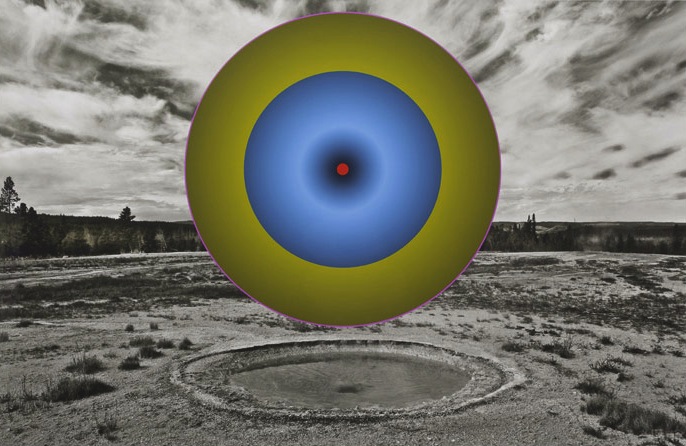
"Throughout his variegated career and across a broad range of media — including painting, drawing, photography, sculpture, and various hybrids — Don Suggs has frequently tinkered with the sacred geometry of the modernist picture plane, subjecting it to unholy alliances with classically mimetic picture-making, usually in the form of pictorial landscapes. Recently his geometric fixations, in this capacity and otherwise, have narrowed to the ideal form of circles composed from infinitely variable bands of concentric color; an iconic visual trope throughout art history, but one of particular centrality to a wide range of modernist strategies, from Kandinsky, Duchamp, and Hilma af Klint to Alfred Jensen, Jasper Johns, and Kenneth Noland. Though these affinities inform Suggs’s work, his principal interest is the structure and dynamic of translation from illusionistic to abstract modes of representation.

The works from his Patrimony/Matrimony series, begun in 2006, derive their rings of color — meticulously applied onto round canvases up to nine feet in diameter using a purpose-designed turntable “easel” — from the palettes of great paintings from across the history of art. It’s something like a spectrographic readout, or core sample. Several other series applied the same formula to archetypal Western American landscapes, either in pure tondo form or as abstract insertions into black and white photographic depictions of the original source location. It’s at this point his most recent exhibit picks up..."


Read the rest of Don Suggs: Abyss Pools and Travertine Springs in ArtVoices

See the show online at LA Louver

Images: Omphalos; Tioga Pass (both 2012 archival inkjet prints)