
Sunday, May 10, 2015
RIP CB


Wednesday, May 6, 2015
The Future of Painting is Chained to Nancy Sinatra Times Five!

Monday, April 27, 2015


Saturday, April 25, 2015
Chemistry Set Cutie!

UPDATES:
Nic Waterman found out a bit from an article on 20s exotica. [Famous Hollywood Pictorialist photographer] William Mortensen was a pupil of Kales. Nic adds: "This image was in a 1928 exhibition at the Smithsonian, so I think it was considered fine art."
from http://historicalzg.piwigo.com/index?%2Fcategory%2F132-west_coast_kales_mortensen_weston_and_mather_vlad
Arthur F. Kales
Nic Waterman found out a bit from an article on 20s exotica. [Famous Hollywood Pictorialist photographer] William Mortensen was a pupil of Kales. Nic adds: "This image was in a 1928 exhibition at the Smithsonian, so I think it was considered fine art."
from http://historicalzg.piwigo.com/index?%2Fcategory%2F132-west_coast_kales_mortensen_weston_and_mather_vlad
Arthur F. Kales
Time Period: 1910s-1936
Location: California
“Arthur Kales (1882-1936), a prolific American pictorialist photographer during the 1920s. Pictorialist photographers believed that photographs should emulate the formal elements of etchings or paintings. Pictorialists renounced the sharp accuracy of a photographic image, thus the film was subdued by soft focus and other photographic techniques. The photographers often planned the picture's scenarios, much like a painter composes a painting. Arthur Kales joined this movement while he was in his late 20s. Born in Arizona in 1882, Arthur Kales moved to California in 1903 where he remained for the rest of his life. Initially pursuing a law degree, Kales found photography instead. By 1918, Kales was deeply committed to the popular Los Angeles pictorialist movement. By 1922 he was a regular essayist for the journal, Photogram of the Year. In 1928, Kales was awarded a fellowship from the United Kingdom's Royal Photographic Society and was given a fifty-print retrospective by the Smithsonian Institution in Washington D.C. Despite his vast repertoire of subject, matter, his work can be identified by his ethereal yet exquisitely intricate compositions."
Location: California
“Arthur Kales (1882-1936), a prolific American pictorialist photographer during the 1920s. Pictorialist photographers believed that photographs should emulate the formal elements of etchings or paintings. Pictorialists renounced the sharp accuracy of a photographic image, thus the film was subdued by soft focus and other photographic techniques. The photographers often planned the picture's scenarios, much like a painter composes a painting. Arthur Kales joined this movement while he was in his late 20s. Born in Arizona in 1882, Arthur Kales moved to California in 1903 where he remained for the rest of his life. Initially pursuing a law degree, Kales found photography instead. By 1918, Kales was deeply committed to the popular Los Angeles pictorialist movement. By 1922 he was a regular essayist for the journal, Photogram of the Year. In 1928, Kales was awarded a fellowship from the United Kingdom's Royal Photographic Society and was given a fifty-print retrospective by the Smithsonian Institution in Washington D.C. Despite his vast repertoire of subject, matter, his work can be identified by his ethereal yet exquisitely intricate compositions."
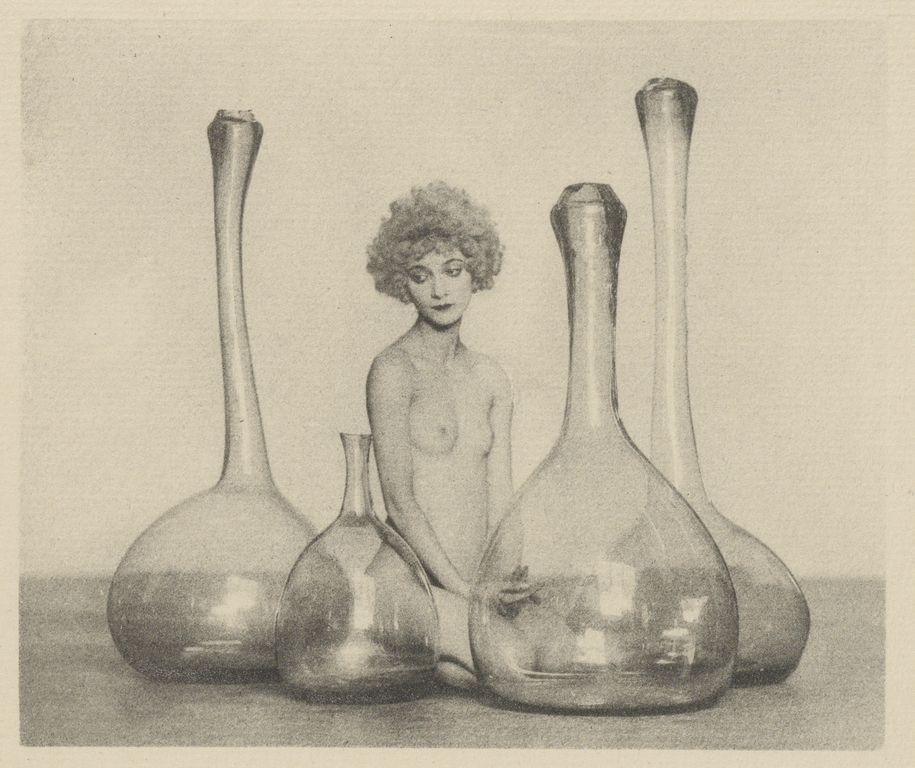
Marguerite De La Motte (June 22, 1902 – March 10, 1950) was an American film actress, most notably of the silent film era. Born in Duluth, Minnesota, De La Motte was the daughter of Mr. and Mrs. Joseph De La Motte. She was a 1917 graduate of the Egan School of drama, music, and dancing.
De La Motte began her entertainment career studying ballet under Anna Pavlova. In 1919, she became the dance star of Sid Grauman on the stage of his theater. In 1918, at the age of 16, she made her screen debut in the Douglas Fairbanks, Sr directed romantic comedy film Arizona. In 1920, both of her parents died, her mother in January in an automobile accident and her father in August from heart disease. Film producer J.L. Frothingham assumed guardianship of her and her younger brother.

De La Motte in 1921.
De La Motte was married twice. She first wed silent film actor John Bowers in 1924, who was then a matinee idol of the silver screen. The couple were separated at the time when Bowers committed suicide in 1936. De La Motte later married attorney Sidney H. Rivkin whom she later divorced after four years of marriage. Her cousin, Clete Roberts, was an American war correspondent and journalist, who appeared in two episodes of the television series M*A*S*H* in the 1970s.
After her film career ended, De La Motte worked as an inspector in a southern California war plant during World War II. Later she came to San Francisco, California, where she worked in the Red Cross office.
On March 10, 1950, De La Motte died of cerebral thrombosis in San Francisco, three months short of her 48th birthday. On February 8, 1960, De La Motte was awarded a star in the Motion Pictures section of the Hollywood Walk of Fame at 6902 Hollywood Blvd., in Hollywood, California.
Turns out it was created using the Bromoil print process, which begs the question "What the hell is the Bromoil print process?" God bless you, wikipedia!
Oil print process
The oil print process is a photographic printmaking process that dates back to the mid 19th century. Oil prints are made on paper on which a thick gelatin layer has been sensitized to light using dichromate salts. After the paper is exposed to light through a negative, the gelatin emulsion is treated in such a way that highly exposed areas take up an oil-based paint, forming the photographic image.
A significant drawback to the oil print process is that it requires the negative to be the same size as the final print because the medium isn't sensitive enough to light to make use of an enlarger. A subtype of the oil print process, the bromoil process, was developed in the early 20th century to solve this problem.
The oil print and bromoil processes create soft images reminiscent of paint or pastels but with the distinctive indexicality of a photograph. For this reason, they were popular with the Pictorialists during the first half of the twentieth century. The painterly qualities of the prints continue to appeal to artists and have recently led some contemporary art photographers to take up these processes again.
The origins of the oil print process go back to experiments by Alphonse Louis Poitevin with bichromated gelatin in the 1850s.
To make an oil print, a piece of paper is coated with a thick gelatin layer containing dichromate salts that sensitize it to light. A contact print is made by laying a negative over the paper and exposing it to light, which leads to hardening of the dichromated gelatin in proportion to the amount of light that reaches the paper. After exposure, the print is soaked in water and the non-hardened areas absorb more water than the hardened parts. The sponge-dried but still moist paper is then inked with an oil-based ink, which sticks preferentially to the hardened (drier) areas. The result is a positive image in the color of the ink. As with other forms of printmaking, the ink application requires considerable skill, and no two prints are identical.
Multicolor oil prints are possible through local inking of the print, and it is also possible to create reverse prints by contact-printing the wet oil print to a piece of plain paper. Artists have also sometimes created variations by applying extra paint using brushes. In the later 19th century, it was possible to buy commercially prepared gelatin-coated paper.
Bromoil process
The bromoil process is a variation on the oil print process that allows for enlargements. In 1907, E.J. Wall described how it should theoretically be possible to place a negative in an enlarger to produce a larger silver bromide positive, which would then be bleached, hardened, and inked following the oil print process. That same year C. Welborne Piper worked out the practical details. Much as Wall envisioned it, the bromoil process starts with a normally developed print exposed onto a silver-bromide paper that is then chemically bleached, hardened, and fixed. When the still-moist print is inked, the hardest (driest) areas take up the most ink while the wettest areas become the highlights.
An issue with the bromoil process is that inadequate rinsing of the chrome salts can lead to discoloration of the prints when exposed to light over long periods of time. In addition, irregularities in the thickness of the gelatin layer can, under unfavorable conditions, lead to stresses that damage the pictorial (ink) layer.
Wednesday, April 15, 2015


Wednesday, March 25, 2015
A Part for a (W)hole – Mike Kelley as avant-garde literature

I haven’t written anything about Mike Kelley since he killed himself just over three years ago, but it isn’t for the reasons you might think. Like most of his friends and acquaintances in Los Angeles, I have decidedly mixed feelings about his career-topping final exit, and sorting those out is an enormous, ongoing, and private undertaking. No, the primary impediment to my weighing in on Mike’s legacy is the fact that his oeuvre – now being complete – is, frankly, mentally and physically overwhelming. For a depressed guy, he sure did a lot of work!
This was literally brought home to me recently when Kelley’s Stedelijk Museum retrospective finally made it back to roost at MOCA’s cavernous Geffen Contemporary facility. But wandering from room to overstuffed room, I experienced an unexpected and paradoxical reaction. I kept feeling there was not enough. That the exhibit was incomplete. Which is crazy – I had already spent 10 hours in the former LAPD garage, and felt I had barely scratched the surface. They couldn’t include every single scrap left behind by the hardest working man in art business, could they?
Could they? It occurred to me that that was exactly what I wanted to see, physically, in one place at one time – Mike Kelley’s complete works, with no missing parts. Not only that, but I wanted it to be a permanent installation, available for repeat in-depth visits over a number of years. It’s not something I could say about many artists (certainly not Clifford Still, who managed to arrange something pretty close) and I realize that such a model is completely unfeasible in the context of contemporary culture, but… there it is.
In a day or two, I realized that my desire was bound up with an understanding of Mike’s art as One Great Work, like some great novel. Very much like some great novel -- characters, plots, motifs, satirical targets, formal devices, and linguistic tour-de-forces recur with rhythmical regularity and subtle (or drastic) variation in Kelley’s work.
Albeit in an immersive, multi-sensory, modular, non-linear structure. With Gravity’s Rainbow or Finnegans Wake I felt that I didn’t quite glean every last drop of meaning and pleasure from the first go-round. Same here. It had to sink in. And I would need to revisit it in a year -- and again in five years, and in twenty, fifty, whatever. Forever. Not gonna happen.
And yet there is an argument to be made for the holographic view – or at least that Kelley’s most deliberately written works contain the template for his larger corpus; the cornerstone of Mike Kelley’s success as an artist has always been his literary virtuosity. Contrary to common wisdom regarding text-heavy pictures, Mike’s dense early black-and-white paintings and drawings actually attract and hold the viewer’s attention. And his early performance art works stood out from the herd of endurance tests and neo-ritualistic costume dramas by the sheer strength and wit of their writing.
Read more in the catalogue for the IMMA exhibit Primal Architecture or ATJ
Tuesday, March 24, 2015
Misunderstanding Sculpture

Having somehow acquired two university degrees in Painting and spending the subsequent 20 years as a professional artist, curator, and critic, I am as sensitive as the next artworld insider to the ways in which art schools, gallery scenes, and the state of contemporary art are depicted in popular narratives. They usually get it embarrassingly wrong.
The medium of comics seem particularly susceptible, riddled as it is with whining fanboys traumatized to learn in their art school foundation year that the drafting chops that kept them from being beat up since the third grade haven’t been considered relevant since 1837. Even brilliant social satirists like Dan Clowes and Chris Ware can miss the mark by aiming at straw men patched together from sitcom stereotypes and Andy Rooney editorials. So it is with some trepidation that I approachedThe Sculptor, Scott McCloud’s first substantial foray into graphic narrative practice after decades devoted to graphic narrative theory, with his inescapable Understanding Comics and its sequels.
The Sculptor tells the story of a young flash-in-the-pan art star wannabe who had his 15 seconds and blew it, but is still hanging around Manhattan as he sinks into despair and oblivion. So far so good! But instead of crawling back to the sticks and staking out a future as an adjunct Community College instructor, our protagonist David Smith (named, oddly, for the most famous mid-20th-century modernist American sculptor) manages a Faustian bargain that will almost certainly get him the prizes he deserves. Antics ensue.
I don’t want to spoil the plot, which manages to be simultaneously formulaic and bizarre, but David is suddenly able to fabricate an enormous number of highly crafted, idiosyncratically personal cartoonish granite sculptures in a very short time. He fully expects this extravagant bounty to redeem his reputation and career, but the artworld’s (quite accurate) response is dismissive, comparing his cluttered studio to a “Polynesian gift shop” and launching him on a shame spiral that quickly leaves him disoriented, homeless, and suicidal. Enter the bipolar aspiring actress with the heart of gold, and David’s chance to learn the real meaning of Christmas. Or something.
Just shy of 500 pages, The Sculptor is an engaging, entertaining read – a surreal potboiler with the fluid, flexible, cinematic pacing you would expect from perusing the author’s theoretical treatises. McCloud’s images are also distinctly filmic, with lots of crane shots and noir expressionist compositions interspersed with too-occasional passages of contemplative observational detail. The ambitious scale and production values are inordinate to McCloud’s track record in fiction, and the effect is ultimately reminiscent of M. Night Shyamalan, whose movies always beg the question “How did this ever get made?” Which is a good thing.
The medium of comics seem particularly susceptible, riddled as it is with whining fanboys traumatized to learn in their art school foundation year that the drafting chops that kept them from being beat up since the third grade haven’t been considered relevant since 1837. Even brilliant social satirists like Dan Clowes and Chris Ware can miss the mark by aiming at straw men patched together from sitcom stereotypes and Andy Rooney editorials. So it is with some trepidation that I approachedThe Sculptor, Scott McCloud’s first substantial foray into graphic narrative practice after decades devoted to graphic narrative theory, with his inescapable Understanding Comics and its sequels.
The Sculptor tells the story of a young flash-in-the-pan art star wannabe who had his 15 seconds and blew it, but is still hanging around Manhattan as he sinks into despair and oblivion. So far so good! But instead of crawling back to the sticks and staking out a future as an adjunct Community College instructor, our protagonist David Smith (named, oddly, for the most famous mid-20th-century modernist American sculptor) manages a Faustian bargain that will almost certainly get him the prizes he deserves. Antics ensue.
I don’t want to spoil the plot, which manages to be simultaneously formulaic and bizarre, but David is suddenly able to fabricate an enormous number of highly crafted, idiosyncratically personal cartoonish granite sculptures in a very short time. He fully expects this extravagant bounty to redeem his reputation and career, but the artworld’s (quite accurate) response is dismissive, comparing his cluttered studio to a “Polynesian gift shop” and launching him on a shame spiral that quickly leaves him disoriented, homeless, and suicidal. Enter the bipolar aspiring actress with the heart of gold, and David’s chance to learn the real meaning of Christmas. Or something.
Just shy of 500 pages, The Sculptor is an engaging, entertaining read – a surreal potboiler with the fluid, flexible, cinematic pacing you would expect from perusing the author’s theoretical treatises. McCloud’s images are also distinctly filmic, with lots of crane shots and noir expressionist compositions interspersed with too-occasional passages of contemplative observational detail. The ambitious scale and production values are inordinate to McCloud’s track record in fiction, and the effect is ultimately reminiscent of M. Night Shyamalan, whose movies always beg the question “How did this ever get made?” Which is a good thing.
Read the rest at The Comics Journal website (or ATJ)
CATHY WARD: MEMORIALS GROWN FROM CLAY AND INK

"Impossibly intricate, nearly-abstract renderings of hair incised into scratchboard; baroque cut-paper collages sourced from porno mags; an immersive environment of carved and painted trees meticulously encrusted with Germanic kitsch; a decade-long exhaustive photodocumentation of food vans; luminous fin-de-siècle paintings for post-punk record covers; a faux-museological recreation of a neo-paganist secret society initiation chamber; a reenactment of the doomed trek of the Donner Party (minus the actual cannibalism) – unlike many artists classified as “outsider”, Catharyne Ward has passed through a succession of distinct phases more appropriate to the career of a mainstream post-studio conceptualist like Mike Kelley or Rosemarie Trockel.
Yet, despite attending the Royal College of Art in London (albeit in ceramics) and hanging with Eduardo Paolozzi, she has managed to avoid being shortlisted for the Turner Prize or gracing the cover of Artforum. So far. Such conventional accolades would not be hard to imagine, given the ambition, timeliness, cross-disciplinary panache and sheer visual beauty of the work, but Ward’s forceful idiosyncracy, authentically subversive political undertones and psychological candour – not to mention her labour-intensive craftsmanship – have kept her outsider credibility intact.
Perhaps the most well-loved works in Ward's diverse oeuvre are her scratchboard drawings of cascading, contorted masses of hair, which have been likened to the work of Madge Gill and Austin Osman Spare. The somewhat disreputable hobbyist medium – a subtractive, even sculptural, drawing practice where a black India ink surface is scraped away to reveal an underlying layer of white china clay – packs a graphic punch, while coming equipped with a whole set of symbolic connotations..."
Image: Surgenesis, 2008, china clay and India ink on board, 16 x 20 ins
Purchase to view the entire article: Raw Vision #85 or continue ATJ
Friday, March 20, 2015


Thursday, March 19, 2015
Michael Parker's JUICEWORK at Human Resources

I haven't been doing much art reviewing lately, but here's an excerpt from "Michael Parker 101," which will be included in the catalog for R.S.V.P. Los Angeles at Pomona College Museum of Art, Fall 2015 (ed. Rebecca McGrew and Terri Geis).
"The history of Modern art could be mined for precursors to relational aesthetics at least as far back as the Dada antics at the Cabaret Voltaire. But most of the current practitioners of this newest of New Genres distinguish themselves by subscribing to a conceptualist austerity of means—favoring deadpan structural and procedural documentation; emphasizing, often exclusively, the social interactions produced by their artworks; and eschewing formalist content, such as the tactile, sensual, and perceptual elements of art and the visual language they comprise.

In his most recent solo exhibition, Michael Parker brought the juice with a vengeance. For Juicework, held at Human Resources in Los Angeles’ Chinatown district over four days in February 2015, the artist filled the cavernous white cube of the gallery—a former neighborhood movie house—with an array of interactive components that took sensual engagement to an absurd but exquisite extreme. Consisting of a dozen or so stations where visitors could produce and consume juice from the abundant supply of citrus fruits (plus a dishwashing area), the installation functioned perfectly as a locus of conviviality, with perhaps a spritz of social commentary (juice boutiques being currently synonymous with the sustainable gentry).

But the pith of the display consisted of over 1000 handmade ceramic artifacts—mostly freeform juice reamers of various sizes, but also sufficient quantities of cups, funnels, trays, and larger vessels to hold the mounds of yellow, orange, and green fruit. The ceramic tools were mutantly variegated in shape, scale, and finish—with organic forms recalling sea anemones and sumptuous mottled glazes in the blue-violet-red end of the spectrum.


Better pictures and more info at: http://humanresourcesla.com/michael-parker-juicework/
Tuesday, March 10, 2015
Tribute/Retrospective for Sean Leis-Beck (1985-2014)

Sorry for the short notice, but if anyone has some of Sean's work that should be included or wants to put in a tribute piece, let me know ASAP! We'll be installing the show next week, and opening a week from Thursday.
Sunday, March 8, 2015

Friday, February 20, 2015
Desert Lighthouse Ultimatum!

Don't miss one of the most auspicious LA solo debuts in recent memory - Daniel Hawkins' Desert Lighthouse Ultimatum, the second installation in the artist's Desert Lighthouse Trilogy, a series of multimedia installations exploring his past and future attempts to erect a full-size fully-functioning lighthouse in the Mojave Desert.
The partially completed show, curated by Tyler Stallings, had a stealth opening at UC Riverside's ARTSblock’s Sweeney Art Gallery in late November, but has recently reached its complete state with the addition of several components, including a set of deliberately lo-res 3D animations of the lighthouse's eventual disintegration, designed for the outdoor jumbotron-style LED displays, and the completion and publication of the Desert Lighthouse Prospectus, a lavish guide for potential financial backers -- which includes an essay by yours truly, which I have excerpted below.

From the press release:
Following hot on the heels of his Desert Lighthouse Protocols [MFA thesis exhibition at UC Irvine] (2014), Ultimatum expands and focuses his vision with an array of artifacts and documents, centering on the fully functioning top 1/5 of the rebuilt lighthouse, but encompassing materials as diverse as the artist’s beautifully painted panoramic backdrops of the actual building site, a pair of oversized bulletin board compositions presenting an intricate non-linear pictorial/informational representation of the Desert Lighthouse saga, and much more!
The official "closing" artist's reception is next Saturday, February 28th, 2015, 6pm - 9pm, but the show is up for another couple of weeks during the regular gallery hours of Tue-Sat: 12pm-5pm -- this is a spectacular cutting edge mashup of innovative land art, experimental narrative, and masterful formalism, in a museum-scaled installation that you won't be able to see anywhere else anytime soon! The Sweeney Art Gallery is located at 3824 Main Street, Riverside, CA 92501.

excerpt from “A STORM IN ANY PORT” BY DOUG HARVEY
"Although ostensibly an architectural Land Art intervention – and, as such, extending its conceptual tendrils to connect with such other desert modifiers as Robert Smithson (no slouch at courting failure himself), Michael Heizer, Nancy Holt, James Turrell, and Walter de Maria (particularly the last three, who have each created signature works that incorporate light and architecture as their central components), Desert Lighthouse incorporates media and genres as disparate as panoramic landscape painting, printmaking, drawing, architectural engineering, performance, relational aesthetics, institutional mimicry, video, sound art, and digital imaging and animation.

In spite of this rich material outpouring, the Desert Lighthouse is at heart a conceptual work -- albeit one that is unafraid to flirt with formalism and narrative when it serves its purposes. Professor Burns does an admirable job of unpacking Hawkins’ initial trunkload of semiotic baggage in his accompanying essay. But as with many Modernist icons – from Duchamp’s Fountain (1917) to Michael Heizer’s Double Negative (1969) to Jeffrey Vallance’s Blinky the Friendly Hen (1978) – the bulk of the meaning is unlocked in the act of displacement.

This central conceit – the displacement of the symbolically loaded structure of a functioning lighthouse into the diametrically opposite environment from the only one in which it makes sense – has provoked considerable speculation above and beyond the official “agoraphobic panic” origin myth. One local observer suggested that the beacon was intended for the Space Brothers, while another speculated on the imminent proliferation of wind-powered desert “sand yachts” after the oil runs out.

Other environmentalist-tinged readings include the DL as a theatrical prophecy of the landscape in the wake of a coming global drought – every lighthouse will be a desert lighthouse; or as a warning about the adjacent contamination plume of hexavalent chromium in the local water table, made famous by Steven Soderbergh’s 2000 film Erin Brockovich – an environmental intervention generated by the anti-corrosive circulatory runoff from a natural gas cooling tower – a dark doppelganger lighthouse, an icy siren, poisoning the landscape to keep its potential energy contained and commodifiable..."
To read the compete essay, purchase a copy of the Prospectus at next Saturday's event, or look ATJ!
Wednesday, February 11, 2015
Last Minute Reprieve

Wednesday, February 4, 2015
Monday, January 26, 2015
F for Failare

Live improvised noise music performance by F (Marnie Weber, Daniel Hawkins, & Doug Harvey with lightshow by Lee Lorenzo Lynch) as part ofJohn Kilduff's Let's Paint TV Retrospective at Blackstone Gallery, 901 S. Broadway, Los Angeles, CA 90015 (9th & Broadway downtown). Friday January 30th. 8 PM. Free for all.
Wednesday, January 14, 2015
YCHTT!

"Do you know what an Artist is now, Lorde? An artist is a conversation piece, nothing more. Like a vase or a kitschy side table. Just something for people to comment on." Discuss.
Saturday, January 3, 2015

Tuesday, December 30, 2014

Monday, December 29, 2014
Chloe Bowie, NW3


Wednesday, December 24, 2014
Outsider Xmas 4 - Now More Than Ever

Click here to go to the free DL page. Tracklist in comments.
Also, these mediafire links sometimes get confused about the source material -- if you have trouble, return her and reclick the link. Reloading the page doesn't work.
Also, these mediafire links sometimes get confused about the source material -- if you have trouble, return her and reclick the link. Reloading the page doesn't work.
(PS: The reason this is #4 is that #3 was a hipster version, and remains unfinished.)
Saturday, December 20, 2014
Peachy Deal!

Hey, because of that movie, the Laguna Art Museum is selling the catalog for the 2000 show "Margaret Keane and Keaneabilia" by Tyler Stallings with essays by yours truly and Judy Vida M.D. for only $10. Dig: http://lagunaartmuseum.org/museum-celebrates-the-release-of-big-eyes-with-special-price-on-margaret-keane-book/
Outsider Xmas Reup 2014

"You may order your pastels from Alaska,
Imported, as the Igloo, in review"
- Evelyn Christmas (songpoem, Vol 2 track 4)
Download Outsider XMAS Vol 1
Download Outsider XMAS Vol 2
Tracklists in Comments
Friday, November 28, 2014

Wednesday, November 26, 2014
Winter Returns the Perfectly Good

Headboards that is! And Winter being Winter Jenssen, who most kindly took it upon himself to complete the "LA Wood" show Perfectly Good Headboards installation by re-releasing the PGH's into the wild, as documented here. Thanks again to China Adams for including my work in this excellent museum-worthy exhibit. EQC4EVER!


Friday, November 7, 2014
Kew. Rhone. 'pataccritically decoded.

I am honored to have been invited to participate in this amazing book about this amazing LP alongside fellow contributors Siegfried Zielinski, Jonathan Coe, Carla Bley, and Robert Wyatt! Not to mention the original perpetrators, Peter Blegvad and John Greaves and a host of others. Available any minute now from the equally formidable Colin Sackett:
http://www.colinsackett.co.uk/images/pdfs/Kew%20Rhone%20Press%20Release.pdf
If you don't know what I'm talking about, get thee to a wiki:
If you don't know what I'm talking about, get thee to a wiki:
Thursday, November 6, 2014
Both Ox and Self Transcended

My performance on last night's Ear Meal is up on youtube: http://youtu.be/Bs5g0OzmyNU -- I always rely on synchronicity to make my art meaningful (less work) and true to form I just found out that yesterday was the exact 45th anniversary of the sentencing of Bobby Seale for contempt of court, the event reenacted on the LP I used in my single-source deconstruction. Mere coincidence?
Subscribe to:
Posts (Atom)